
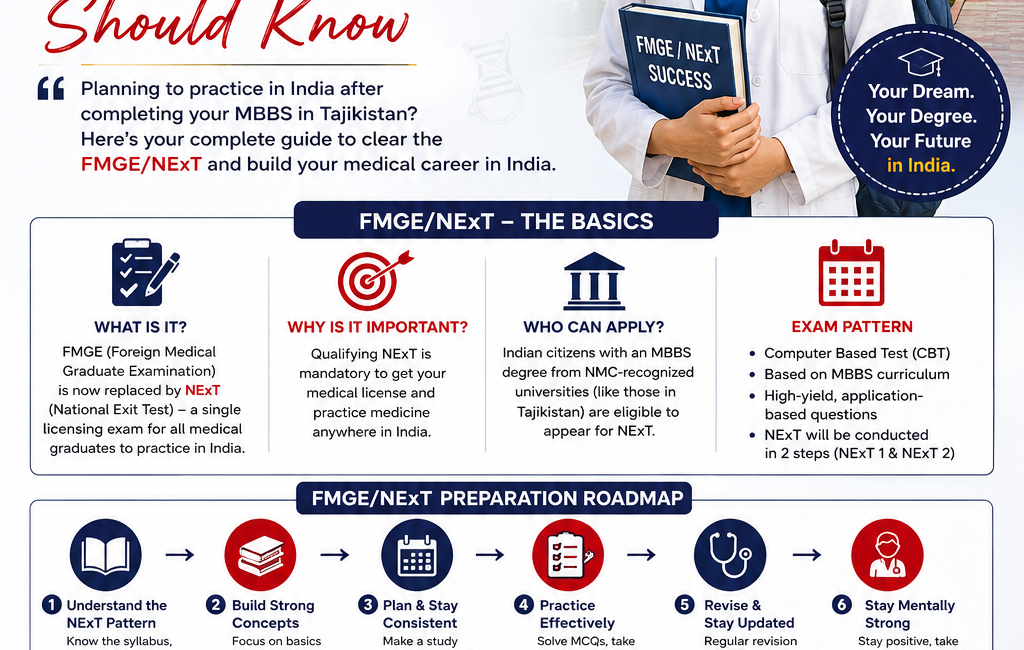
FMGE/NExT Exam Guide: What Trivandrum Students Studying MBBS in Tajikistan Should Know
admin
August 18, 2026
If you’re from Trivandrum and pursuing (or planning to pursue) MBBS in Tajikistan, there’s one exam that will define whether your degree translates into a medical license in India: FMGE, soon to be replaced by NExT. This is the single most important thing to understand before you fly out — and the one area where good planning makes the biggest difference to your career.
Here’s everything you need to know, explained plainly.
The Foreign Medical Graduate Examination (FMGE) is a licensing exam conducted by the National Board of Examinations (NBE) for Indian students who complete their MBBS from a foreign university, including Tajikistan. Passing it is mandatory to register with the National Medical Commission (NMC) and practice medicine in India.
The National Exit Test (NExT) is designed to eventually replace both the final MBBS exam for Indian graduates and the FMGE screening test for foreign graduates, creating a single common licensing standard.
Key points Trivandrum students should know:
Given the shifting rollout, it’s worth checking the latest NMC notifications yearly rather than relying on older information — the applicable exam for your graduating batch may depend on your admission year.
Many students focus heavily on getting admission and less on preparing for the exam that comes after graduation. This is a mistake. Historically, pass rates for foreign medical graduates on FMGE have been lower than pass rates for domestic MBBS graduates on their final exams. The reasons are usually structural, not about intelligence or effort:
The good news: none of these are unsolvable. They just require early, deliberate planning.
1. Start early — ideally from year 2 or 3. Don’t wait until you’re back in India. Build a habit of revising Indian MBBS-pattern MCQs alongside your Tajikistan coursework.
2. Choose a university with strong clinical postings. This is where consultancy guidance matters. Universities with better hospital tie-ups and hands-on patient exposure tend to produce graduates who find the practical side of FMGE/NExT less unfamiliar.
3. Use India-specific MCQ banks and standard reference books. Popular resources among Indian students studying abroad include NBE’s previous year FMGE question papers and standard Indian MBBS textbooks (like those used for NEET-PG prep), which align closely with the exam pattern.
4. Join an FMGE/NExT-focused coaching program. Several institutes offer online coaching specifically for foreign medical graduates, with recorded lectures you can access from Tajikistan. Many Trivandrum students start these in their final 1–2 years.
5. Take mock tests seriously, not casually. Simulated exam conditions help identify weak subjects early, when there’s still time to fix them — not two months before the real exam.
6. Connect with seniors who’ve already cleared it. Nothing beats real advice from someone who studied at the same university and went through the same transition. Ask your consultant to connect you with alumni.
| Stage | What to Focus On |
|---|---|
| Year 1–2 | Build strong fundamentals; don’t ignore basic sciences |
| Year 3–4 | Start light FMGE-pattern MCQ practice alongside coursework |
| Year 5 (Final year) | Serious, structured FMGE/NExT coaching and mock tests |
| Post-graduation | Dedicated 3–6 months of full-time exam prep before attempting |
MBBS in Tajikistan can absolutely lead to a successful medical career in India — but the degree is only half the journey. Clearing FMGE (or NExT, depending on your batch) is what turns that degree into a license to practice. Students who treat exam prep as a 5-year habit, not a last-minute scramble, consistently do better.
As study abroad consultants in Trivandrum, we don’t just help you get admission — we help you plan for what comes after: the right university for clinical exposure, realistic timelines, and connections to FMGE/NExT coaching resources. That’s the difference between finishing MBBS abroad and actually becoming a practicing doctor back home.
